
 December 27, 2025
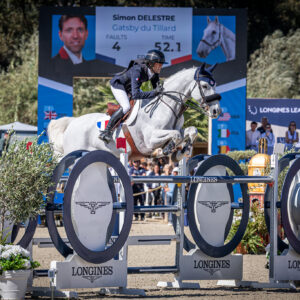
Back in July, four Belgian boys (boys, simply for the alliteration, had they hailed from Malaysia or Madagascar they would have been men) took team gold at the Longines FEI Jumping European Championship held in Spain.
That contest crowned the Belgian team, but left unanswered a tantalizing question: who is the best of the Belgians?
Some would look to the ranking list to answer the question, where a certain Gilles Thomas sits in the 5th spot in the world. He also grabbed bronze in the individual final at those same championships. However, whoever posited Thomas would be dead wrong: the answer is Pieter Devos, who currently sits all the way down at 53rd in the world.
How do I know? And how do I know it’s not only NOT Thomas, but not Thibeau Spits nor 13th-in-the-world Nicola Philippaerts?
I know because last night I watched The Battle of the European Champions, which took place in Mechelen, Belgium.
This battle resurrected an old formula, last used in earnest at the 2014 World Equestrian Games, in which the final four riders vying for the individual champion title all rode each others’ horses, in a labyrinthine matchup.
In the olden days, the main purpose of equestrian sports was training for killing and for a quick getaway after said killing. Horses needed to be able to clear obstacles and barricades put up by the enemy and to be able to pirouette in place so that a rider could cut down the enemy with his sword in a full 360-degree massacre. Hence the modern sports of show jumping and dressage.
One can see the past clearly reflected in the modern pentathlon, which, until the disaster of the Tokyo games, where a German coach punched a hesitant horse, involved the athletes riding an unknown (to them) horse and jumping it over small fences, in a display of some of the worst riding imaginable. This was necessary because a soldier, after raping and pillaging, needed to be able to grab whatever horse was at hand, and also needed to be able to run away (cross country), fight his way out (fencing and pistol shooting), and maybe even escape via a waterway if necessary (swimming).
The modern world has largely replaced horses in the military with tanks and drones and other such things, and so equestrianism has evolved away from chaotic catch-riding to a more technical and nuanced place, where partnership and communication with your horse is both valued and necessary.
Some still long for the old days, when individual horses and humans were considerably less cherished, in fact easily disposable, and watching either be injured was high entertainment for the audience, like the slaughter seen in the coliseum of Rome in days of yore.
Who wants to return to that world? Not me, and not many horses or riders either. But if we don’t return there for at least one night, we will never know that Pieter Devos is the best!
So we begin. Each rider brings a horse. I am not in Belgium, so I am watching via live feed. The scene opens to a smallish indoor ring, which is cut near to one end with a set of blockades to form a small warmup area, the other part of the arena being the course, which is not overly high or technical.
We are in Europe, in what is called the “indoor season,” ie, winter. Well, by “we,” I do not mean “me,” because “me” is watching from my bedroom in Wellington, Florida. Good thing, because the indoor season in Europe emphasizes the late start time. It’s written down as 9:30pm, which seems absolutely punishing to an equestrian up at 5am, but is very early for a European, who does not consider dinner before 10pm, which is approximately when the loud EDM music and flashing lights pause for the class to begin.
The lights go up over empty stands. This is probably because everyone is out at dinner or searching for a refill of their sparkling water. It is certainly not because this class is an utter bore.
They start on their own horses. There are three commentators in the ring who commentate endlessly, but their language is not English nor French and is therefore impenetrable to me. I try complaining to my editor, who has given me this assignment, but she is unmoved, and so I must fill in the gap with my own impressions.
The light is overhead and garish and the riders look extraordinarily thin and pale, all except Philippaerts, who brings a slight swarthiness and some body to the saddle.
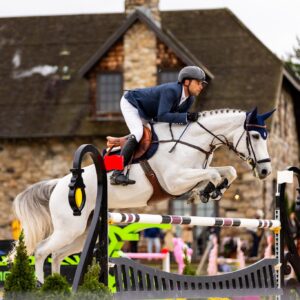
All the riders give slow, steady, respectful rides to the unfamiliar horses. There is nothing pentathlon-style in this exhibition, it is a display of horsemanship. That also makes it super boring. Partnership fits horse to rider like a glove, at its best communication between the two is so subtle as to be hardly perceived. It allows for the tight, smooth, and fast rounds we thrill to at the elite level. It is, in my mind, exactly what makes the sport beautiful and exciting.
And between rides is the long process of untacking and retacking the horse. Each rider has brought a saddle, which he uses on every horse. How is it possible? asks the person who has been contemplating where to put extra saddle racks in the third tackroom at her stable, for one or two or three or twelve are not enough, since each horse has its own saddle, expertly flocked and fitted for maximum comfort and performance.
Should they not be going bareback, I wonder. Does a soldier really have time, in his desperate flight from the scene of slaughter, to tack up a horse?
It is now 2am in Belgium and we are only halfway through! All the riders are tied at this stage, 4 faults each.
I will admit to perceiving what might be a slight advantage in the case of Devos: he has brought something careful. His horse, Diabelle PS, a 10-year-old mare by Diatendro, has not touched a fence. She will be the only horse to go fully clear all night.
A few more hours pass and we have made it to the last and final round. Going in, all the riders are tied at 4 faults a piece. Thomas is on Spits’ horse, Devos is on Thomas’s horse, Philappaerts is on Diabelle PS, and Spits is on Philippaerts’.
Thomas gets a rail and brings his score to 8. Spits also gets a rail. Both of them drop out of the battle. Devos and Philippaerts go clear and we have a jumpoff!
In the jumpoff, we are back to the riders on their own horses. Devos goes first, and continues the clear-round streak of Diabelle PS. Philippaerts gets a pole mid-course then bowling-balls the last fence, taking out every rail, for a final jumpoff score of 8 faults. He is not the champion of champions.
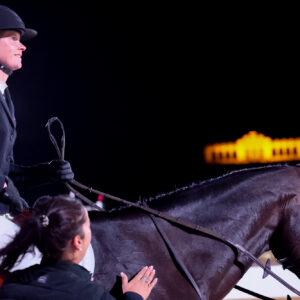
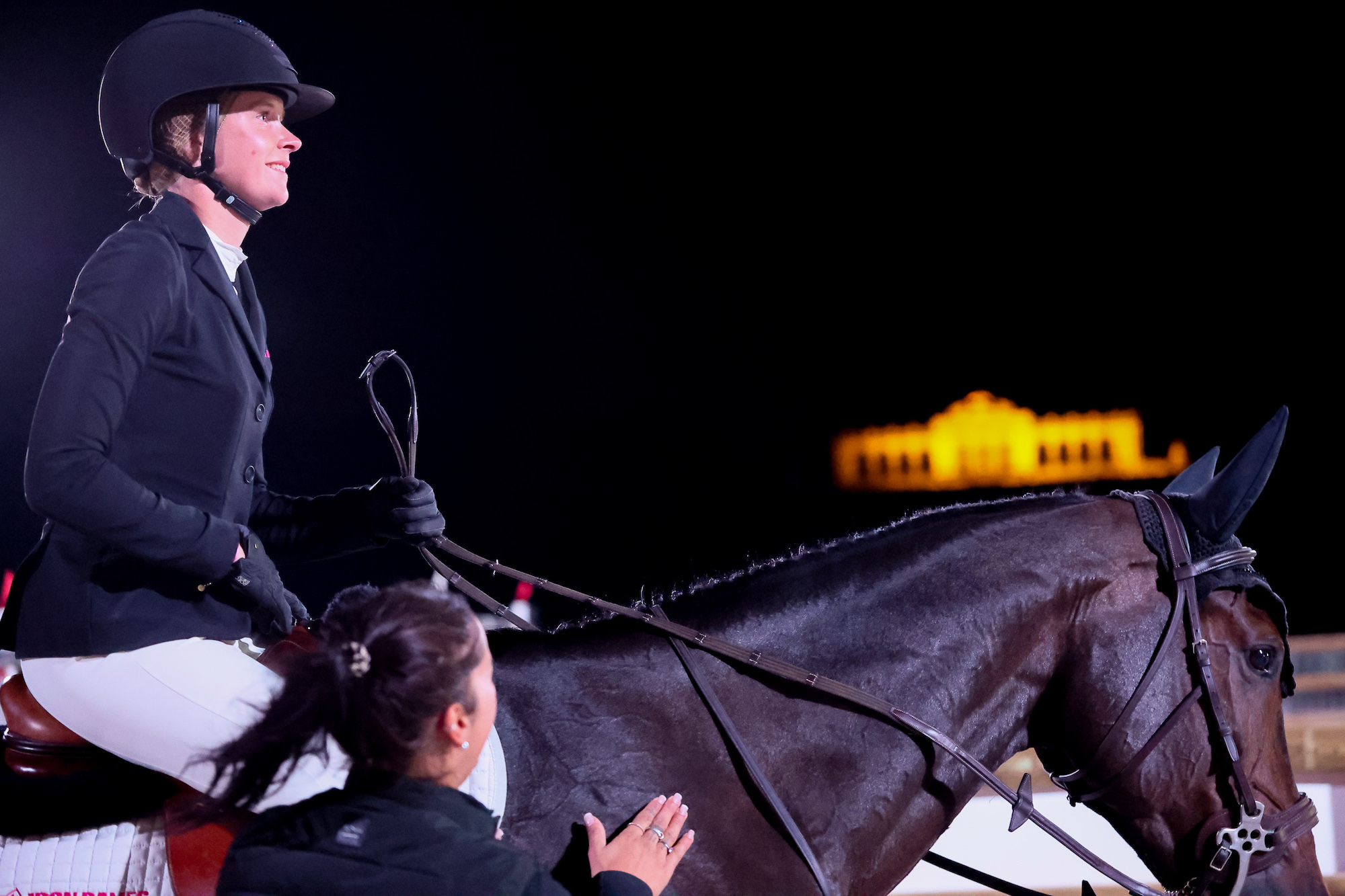
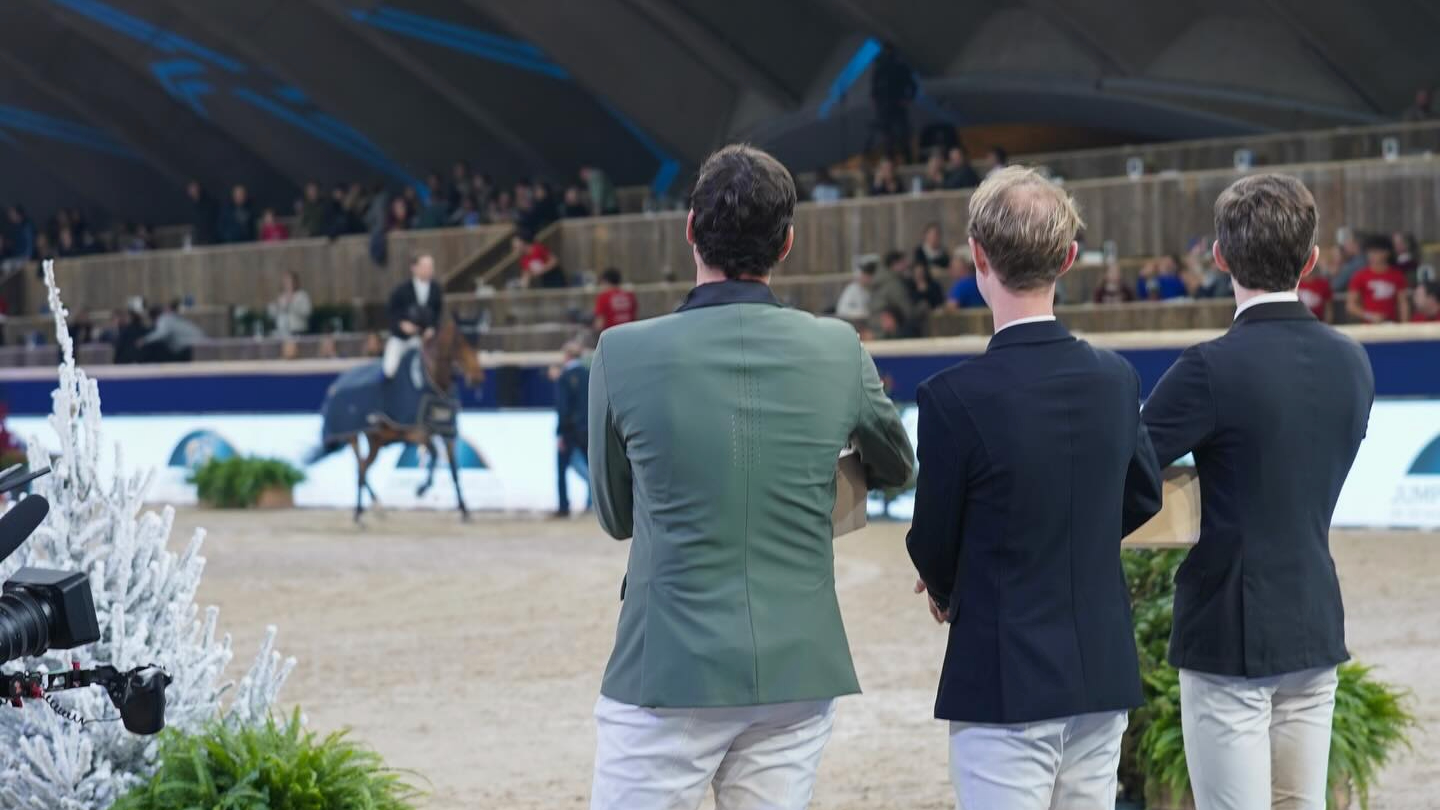
The Champion of Champions is Pieter Devos, who sits astride Diabelle, festooned with a slick cooler and ribbons, while the other, lesser riders—their other, lesser horses disappeared—stand awkwardly on a mat, looking small and defeated under the too-bright spotlight.
Be social! Follow Erica Hatfield & Eye Candy Jumpers: