
 June 5, 2026
Don’t land on me.
It was the only thought running through my mind as I catapulted through the air.
Please, don’t land on me.
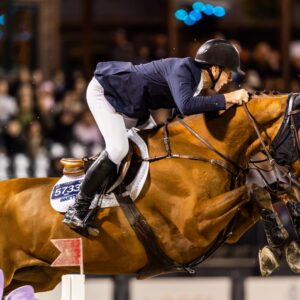
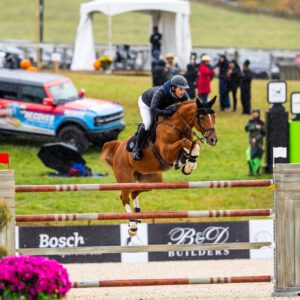
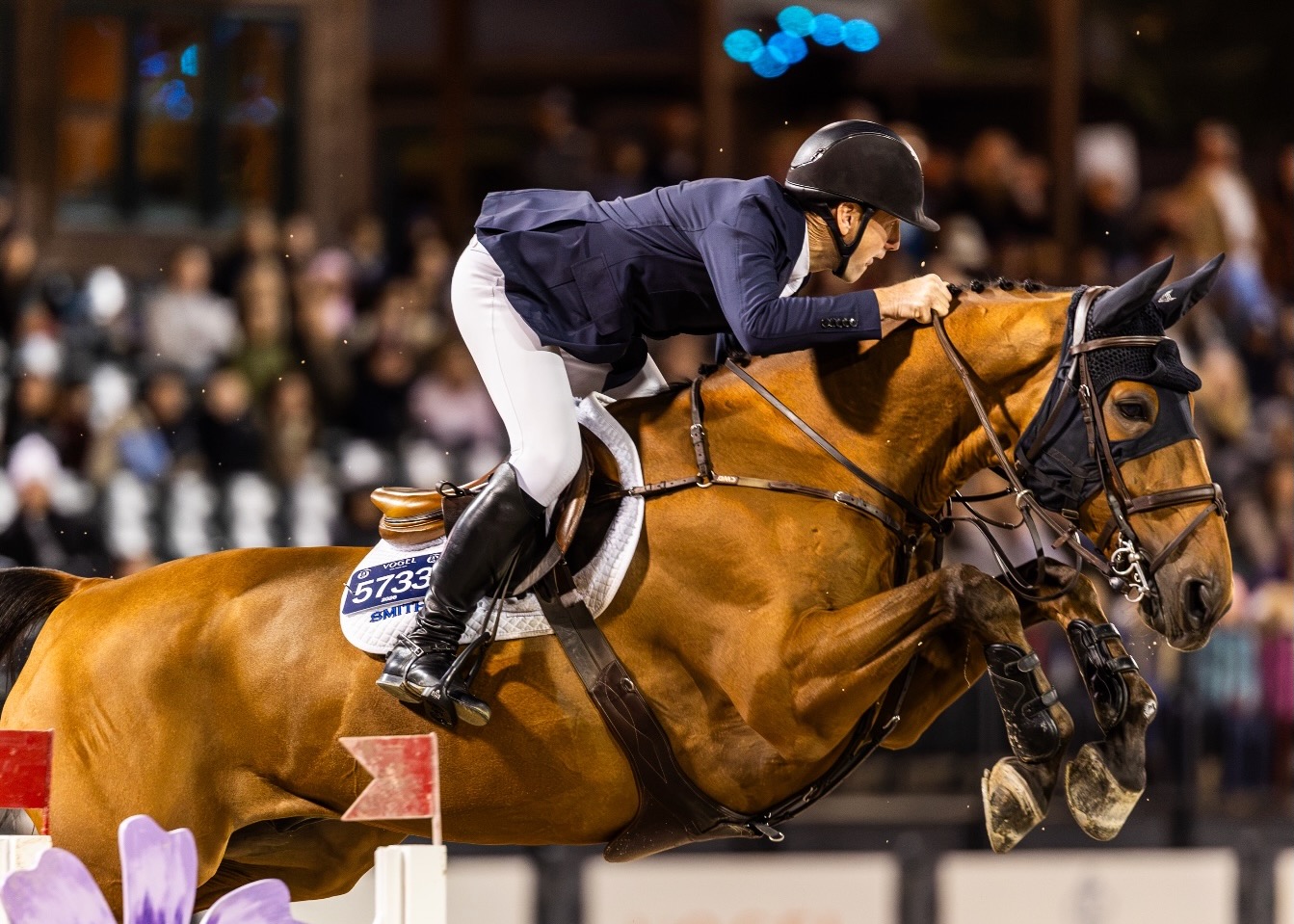
It was supposed to be a training round. Goodbye, my feisty partner of nine years, was in great form. We had just gotten back from Mexico where she was top three in our last two international classes and starting our week at Desert International Horse Park. It was our first class, a 2* Speed. I was aiming for a nice normal round. But when she stepped on herself in front of an oxer and left the ground weird, I knew we were going to go down together.
Please, don’t land on me.
I hit the ground in front of her, and she tried to avoid me. She couldn’t, but she tried. Goodbye’s hoof kicked the helmet off my head, and made contact with my unprotected skull.
By the grace of God, she didn’t kill me. I mean, she nicked my head, but it could have been so much worse.
That fall was not the first time I’ve been caught between the ground and a 1200-pound animal. In 2016, my five-year-old stallion spooked and flipped, landing squarely on my body—I fractured my pelvis, part of my lumbar spine, and dislocated my hip. At least this wasn’t that.
I was unconscious for about a minute. When I came to, I felt the swarm of people rushing into the ring to my aide.
“I’m fine,” I told them.
“How old are you?” I heard someone ask.
“Old,” I replied.
I thought I was funny. They didn’t.
Next thing I knew, I was in a helicopter for the first time. They were stapling my head shut as blood rushed down my face and something came out of my ear. Maybe it was because of the first accident—or maybe because there wasn’t a mirror on site—but I wasn’t scared. I looked bad, there was a lot of blood, but I think my parents were more in shock than I was.
At the hospital, the official diagnosis was a fractured skull.
The words, “When can I be back on the horse?” involuntarily left my mouth.
This was my second miraculous survival. The first had made me realize just how much I love my sport. I knew after getting back in the saddle then that I would never again take it for granted. And I didn’t. I love what I do. I love my horses, I trust them implicitly. I choose this life.
So naturally, I wanted to know when I could get back in the ring. But then, my eyesight started to get fuzzy. They identified the liquid coming out of my ears as spinal fluid. Then, half of my face stopped working.
I started to realize, Oh, this is serious.
I couldn’t close my left eye or speak out of that side of my mouth, or even eat for that matter.
Nerve damage is hard to predict. The doctors couldn’t tell me the extent of the damage, but they estimated it could be around six months before I would get my faculties back.
After a couple weeks, I started to wonder, when is it going to get better? I can’t ride like this. I can’t even go to the supermarket like this.
The scariest part was that my vision was not improving. It was actually getting worse.
You appreciate things much, much more when you lose your eyesight. I started thinking, you know, I don’t care if my face comes back or not. I can function with half my face. But I can’t really function without my eyes.
I was once again staring down the possibility of never being able to compete.
It makes you take stock and appreciate life. The ability to wake up every morning and smell the coffee, to see the flowers, to put on my shoes and go for a run, to just be with my magnificent animals whether I’m riding or not—it was all suddenly at risk.
And then, none of that mattered. Because at the same time I was in the hospital recovering, my dad was diagnosed with cancer.
Doctors had identified an incredibly large tumor going into his skull. They wanted to do emergency surgery in the next four days. Everything that had just happened to me fell away. If I didn’t move my face again or if my eyesight wasn’t perfect, it didn’t matter. My dad being alive and healthy did.
We had a very short window to find alternative solutions. We got a second opinion from MD Anderson Banner where a radiologist told us about a clinical trial out of Jerusalem where they would insert a tiny radiation dart known as an alpha dart into the tumor and dissolve it from the inside. They thought he may be a candidate, and miraculously, he was accepted into the trial.
This was late December 2024, and I was back home at my parents’ house in Arizona. Christmas is meant for joy and celebration. We were living day by day just praying for the best. But despite the circumstances, we were so grateful to come together as a family and to have each others’ support.
Every stressful situation is an opportunity. You can be stressed, or you can look at it as an opportunity to persevere, overcome and be optimistic about what’s in front of you. I entered the battle against my dad’s cancer without being able to see or use my face properly. But I had faith that he was getting the best treatment and he would be okay.
For weeks, it was me sitting on the sofa willing the left side of my face back to life. It was constantly, Can I make things move? Can I make my mouth move? Can I smile? Can I smile? Can I smile? I would wake up in the middle of the night and check—is it back yet?
Every day I would try to see myself in the mirror. But all I saw was a blur.
In my weaker moments I asked my dad, “What if my vision doesn’t come back? What am I going to do?”
“Have faith,” he told me. “It’ll come back.”
There’s a reason for this, I told myself. Just keep going.
On Christmas morning, I was standing by the tree my mother and I had decorated the night before. My vision had been too blurry to really see what I was doing, but I was able to get close enough to hang a few ornaments.
That morning, I did a double take. Wait, I thought. I can see the tree! It wasn’t perfect, but heck, I could see the tree!
And things started to get better. I was given glasses that helped with the double vision and blurriness. By mid-January, my face came back to normal. Then, by February, I lost the glasses, and my vision was spot on.
The biggest miracle of all, though, was my dad’s recovery. Within two weeks of inserting the alpha dart into his tumor, the tumor was gone. He was in remission.
Throughout January I rehabbed at USOPC alongside professional baseball players, and Olympic figure skaters. We would do balance exercises meant for professional ballerinas and gymnasts.
“I ride farm animals for a living,” I told them. “You’re asking a bit much of me, aren’t you?”
They would have me try to read a chart for professional pitchers. At first, I couldn’t see halfway down the page. By February, I was reading the whole thing.
None of the doctors could believe my eyesight came back that fast. Two months after the accident, I was cleared to ride again.
As soon as I was cleared, I was at my barn in Florida. Climbing into the saddle, there was a familiar feeling. Some may call it nerves—that feeling of your heart jumping into your throat before a big competition—or some could say it was justified fear after everything I had gone through. But for me, both fear and nerves come down to one simple emotion: doubt.
I knew I needed to lose the doubt as quickly as possible. In myself, in my horses, in my ability to compete. So I got on my big loveable steady Eddie, who I knew would have no problem clearing a rail on the ground.
We started with cavalettis. Okay, that felt really good.
Next, we tried some small rails.
I could see the jumps, I could find my distance. I was a little nervous, but I got over it.
The next day, we went a little bigger and I jumped a little meter course.
Everything felt right. I kept moving forward. My number one focus was to build back my trust in my horse.
From the time I arrived back in Florida to the time I was in a show ring was less than two weeks. For me, it wasn’t about getting back quickly, it was about pushing through my doubt. I embraced my new motto, If I’m afraid of it, that’s more reason I should do it.
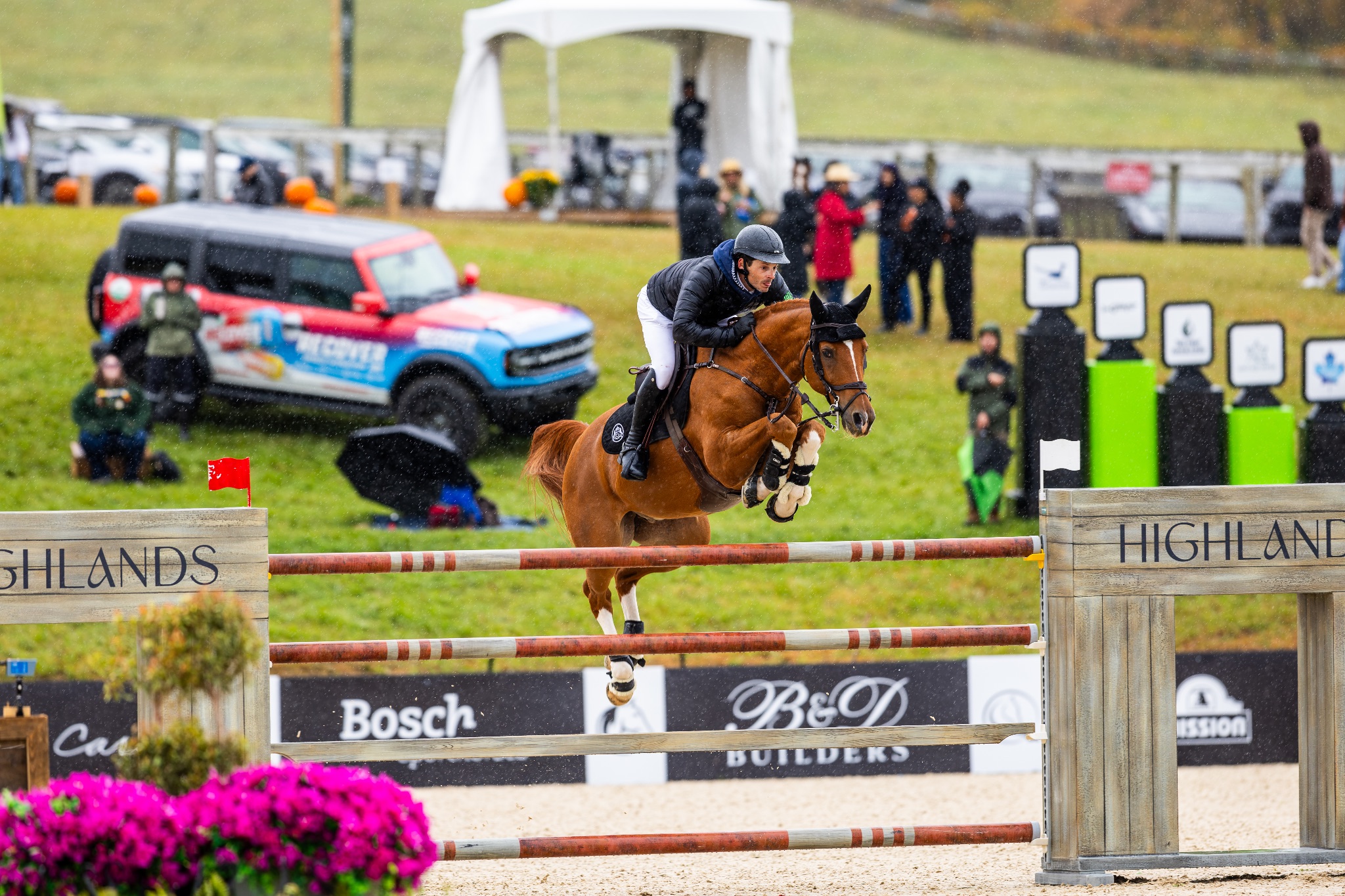
My first show back was at Terranova. I wasn’t sure I was going to compete when I entered FEI, but I showed up and jumped all of 1.20m, which felt good. Next, I tried 1.40m. Then, we jumped a clear 1.45m. My doubt wasn’t silenced, but I had faith so I kept going.
Over the next few months, I was back in competitions, but I was still unsure what my future would hold. What shows do I do? Do I try for a team? Am I ready for a team?
After my second accident my mother swore off attending any shows, but her faith in me never wavered. When I told her, “I don’t know if I’m ready. I don’t know if I’m good enough,” she said, “I think you should try for every single one of them. You can do it, your horse can do it, and I don’t see why not. Why would you doubt yourself? Never doubt yourself.”
In horse sport, we have a very short-term memory of our successes, but those failures and fears will pop up in your mind every day. I am grateful my mother was there to remind me of my success.
And I am grateful for the trials and struggles that followed my accident.
I wouldn’t wish these circumstances on anyone, but they were blessings in disguise and have given me such more appreciation for the little things in life.
I am extremely blessed that I am alive to tell these stories and to continue doing what I love.
I accept that hard things are going to happen in life, and that it is up to me how I approach those difficult situations. Do I accept them as a challenge? Or as an annoyance?
Now more than ever I choose to be positive and to have faith.
I am very blessed, and I know I am here for a reason.