
 April 13, 2026
The text came through: “Kent ‘I don’t pay much attention to my feelings’ Farrington.” Laughing emoji.
It’s the last moments of the World Cup Finals in Fort Worth, Texas. I’m watching from the event pavilion at my farm in Wellington, Florida, surrounded by equestrian professionals and caressed by a balmy April breeze traveling in from across the Everglades.
“How did you feel riding in there today?” asks the interviewer.
“Focused. Just very focused on my job and what I had to do. I don’t put much thought into how I feel, I’m more trying to execute my plan.”
“He’s a machine,” I say, enviously.
For if one thing is paid attention to around here, it’s feelings.
I start thinking of the triune brain model, proposed by Paul MacLean in the 1960s. We have the reptilian brain, the oldest part, where survival instinct lies. Then we have the limbic system, layered on top, the seat of emotion. And finally, the neocortex, responsible for higher-level thinking, responsible for rational thought, the part walking the course and laying the plan. The part Kent uses exclusively.
“I’m going to cry,” says the man sitting next to me, emotional over Kent and Greya’s win. For that’s what they’ve done. After leading the competition from tits to ass over three days—
Tits to ass? What the f-ck are you writing? The flow of the words stops abruptly and I become angry, frustrated.
“The Longines FEI Jumping World Cup winner, how does that sound?” asks the interviewer.
“That sounds great, that sounds fitting,” replies Kent with a smile.
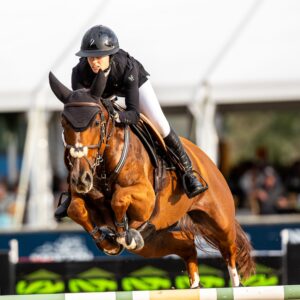
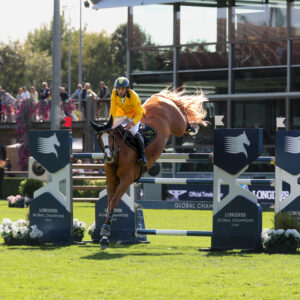
Fitting indeed. It was a week of dominance for Kent. First he took the win with Toulayna in the opening speed competition, then handily won the second round in the Final with Greya, going into Sunday’s last, two-round competition with The Great grey on a score of zero penalties. Steve Guerdat of Switzerland followed on a score of 4, Kevin Staut of France on a score of 6, and Japan’s Eiken Sato and Germany’s Daniel Deusser followed on scores of 7 each.
In a sad blow for his fans was the scratch of Sato and his mount Chadellano JRA, following their spectacular second-place finish on Friday. The 15-year-old gelding showed mild signs of colic after passing the second horse inspection and was brought to the clinic and withdrawn from the competition in an abundance of caution. “I will do my utmost to ensure that he can soon deliver a magnificent performance for all of you,” writes Sako in a social media post.
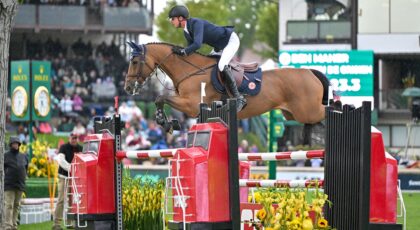
The final day of competition begins by bringing back the top 30 horse-and-rider combinations. The course is set, cruelly for some, with a wall formed by the skull and horns of those famous Texas longhorn cows, the thin and mostly empty bottom consisting of the hollowed-eyed stare of the steer blooming into a vast and arid Texas landscape over the sweeping horns.
The course designer, Anderson Lima of Mexico, has placed the wall as the third jump, coming after a 360-degree rollback, and even though he has set the back of the jump, a solid brown color, facing the horses and not the hollow-eyed stare, it still proves a tricky obstacle for many, with more than one horse giving an initial “no thanks” and requiring a circle and second attempt.
But this is not the obstacle that foils Greya, who gives it a good look and a tall jump. No, it is the flimsy plank at jump 6, after the triple combination, that she takes down.
“Very, very cheap fault on the plank. I mean on a normal pole that stays,” says Kent afterwards.
“Oh, my goodness!” sighs Lauren Hough, technical expert and commentator as the plank goes down.
“Right,” breathes fellow commentator Phil Ghazala, because we all know we’re in for it now—a nail-biter of a second round. Greya’s 4 faults have put Deusser on 7 and Guerdat on 8, both within a one-rail striking distance of the win. Staut has slipped to fifth with 4 faults added to his 6.
Round B of the third competition brings back the top 20 horse-and-rider combinations, again in reverse order of their standings. The first to mention is Richard Vogel, world number 3, who struggled and even fell off in the beginning of the week, but rode determinedly on Sunday to put in a double clear and redeem his trip to Fort Worth.
Next we have Katie Dinan on the American-bred mare Out of the Blue SCF, who came into Sunday on 9 penalties and kept it there with a faultless two-round performance. Rene Dittmar of Germany also ends the competition on 9 faults, but with a slower second-round time, slots in behind Dinan.
And of course we have Deusser on Otello de Guldenboom, that beautiful dark bay stallion by Tobago, who applies maximum pressure by going double-clear on the final day and staying at 7 penalties.
So if Kent gets a rail in the second round, Deusser wins.
We are all squirming in our seats in the pavilion. In Dickies arena, the crowd holds its breath. After the first round, the crowd let out a cheer for Kent and Greya, which Kent immediately squashed with a downward movement of his hand. Was that to calm Greya, the crowd, his own riotous emotions?
Or to remind us all that outbursts from the limbic brain have no place where well-laid plans live?
But I am a writer, not a rider, though the words sound almost the same and I test a tongue twister, saying both words alternately and quickly until they blend into one.
Kent and Greya enter the ring.
“Only a clear will do,” comments Phil Ghazala.
“Get the job done,” says Lauren Hough.
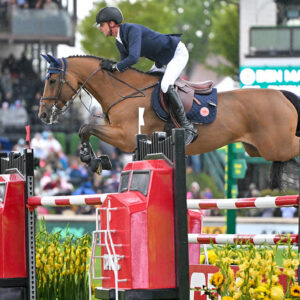
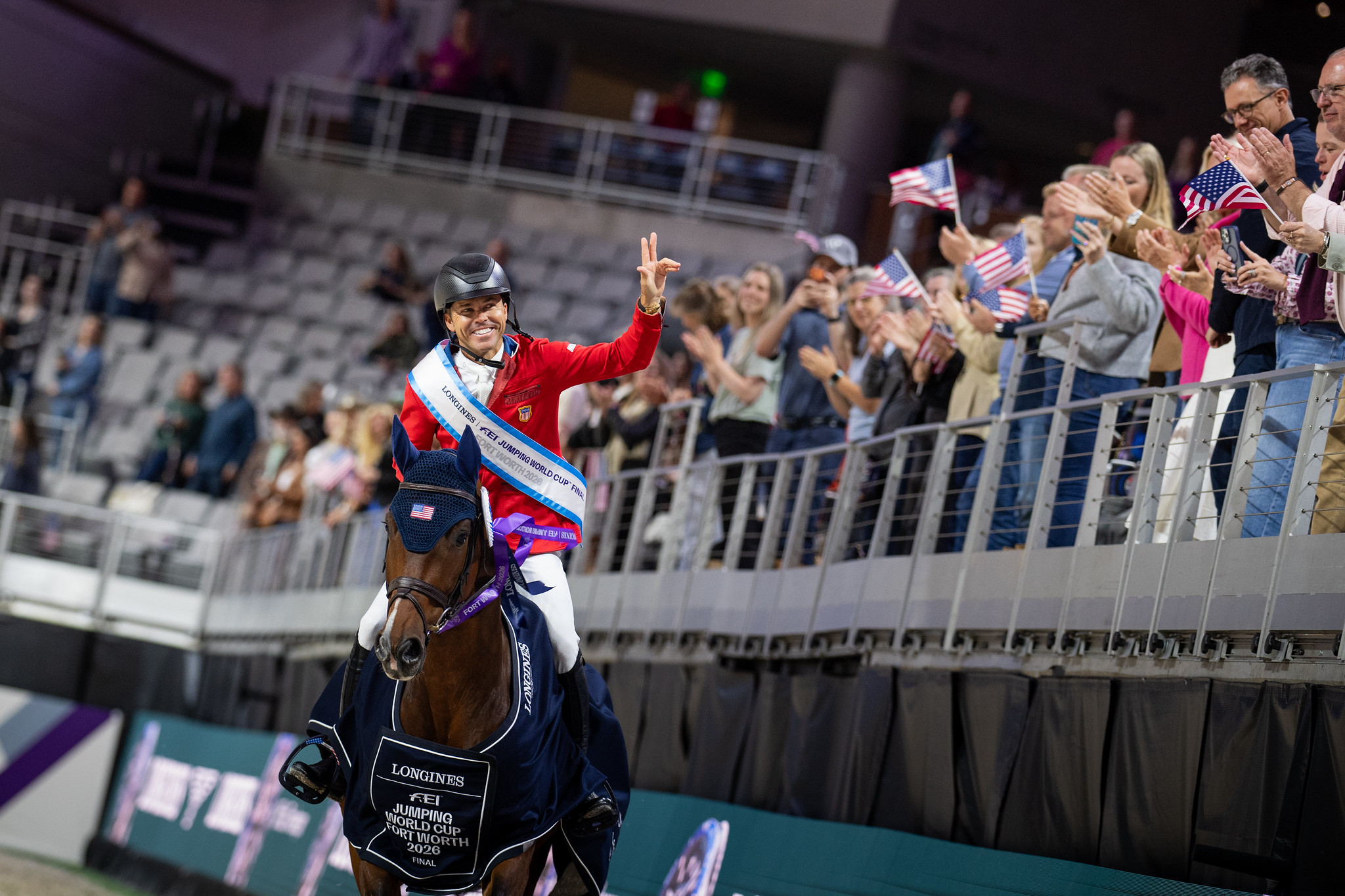
And they get the job done, crossing the finish with a clear and this time Kent makes no move to quiet the crowd, instead taking off his helmet in acknowledgment of the accolades.
Kent Farrington, winner of the World Cup title.