
 March 13, 2026
From one-hit wonders to dark horse victories, a singular triumph always runs the risk of being called a fluke. But to win the same, inaugural event two years in a row? That’s a statement in itself.
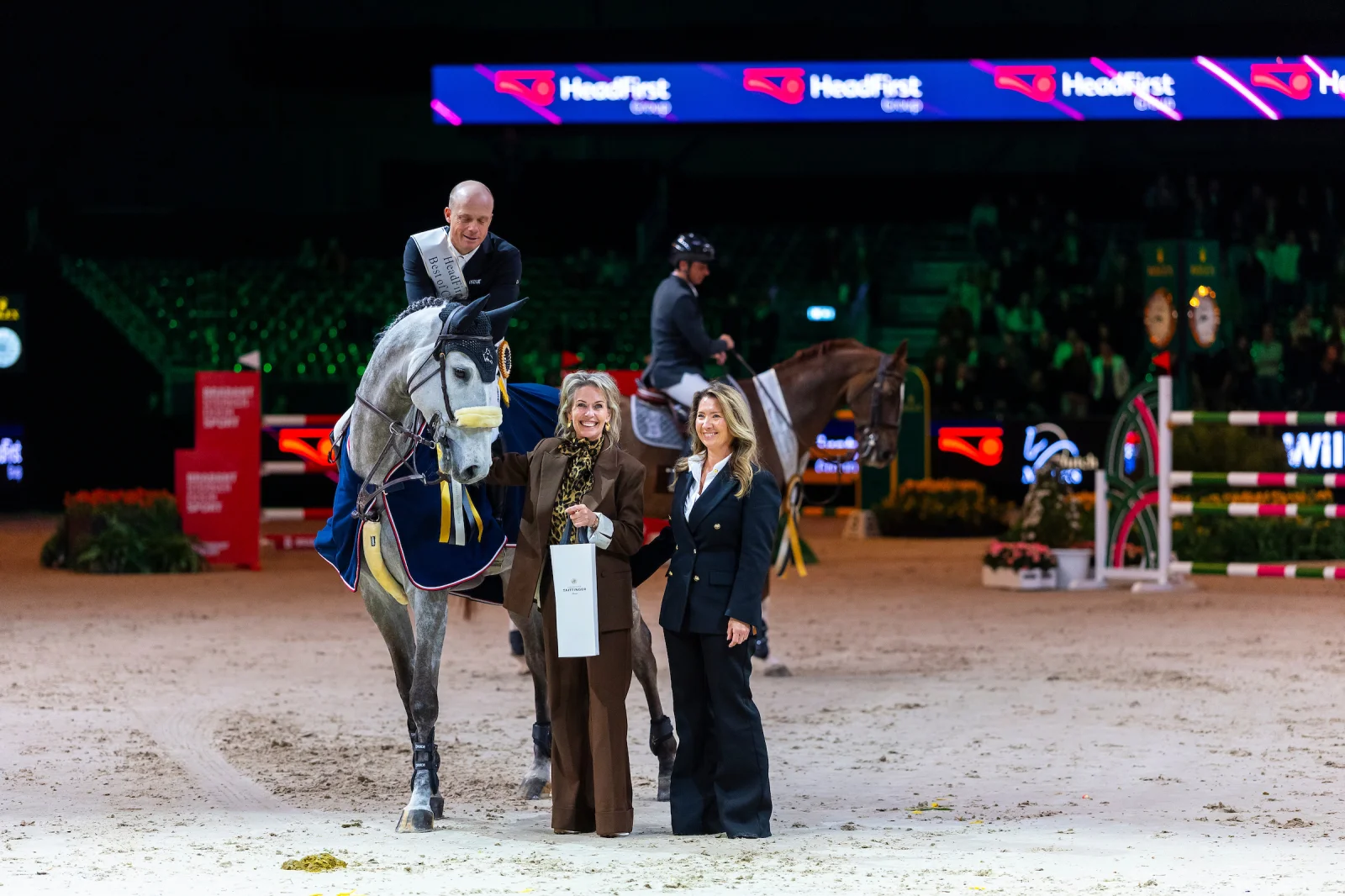
And that’s just what the Netherlands’ Willem Greve did in the hallmark class of the evening on Thursday, March 12 at the Dutch Masters, defeating World No. 5 Gilles Thomas (BEL), World No. 4 Richard Vogel (GER), and World No. 8 Julien Epaillard (FRA) to take the second annual Best of Champions title. Greve, himself, is ranked at No. 24 in the world.
In accordance with the class’s unique format, the Dutch rider piloted his own 9-year-old Zangersheide gelding, Sir Minka Z, in the first round of the 1.45m class, then switched horses—jumping each of his competitors’ mounts in turn. Each combination had only two and a half minutes to get a feel for the course. Then, the bell rang, and their round began.
“This class is really extremely fun. In a short time, you, as a rider, have to try to read the horses well, feel how they react, and how they prefer to be ridden. You shouldn’t try to completely force them to your will,” Greve said.
“We were all really looking forward to it. We’re all extremely involved with our horses, and find it interesting to see how someone else approaches a horse. You share that information with each other, and it’s fascinating to see how someone adapts to a horse.”
After four rounds, only Greve remained on a fault-free score. Vogel finished second after dropping a single pole with Thomas’s mount, the 9-year-old Selle Français stallion, Happy Landais. Vogel earned a superlative of his own, however, recording the fastest time per round on each horse he sat on.
Over four rounds, in fact, Vogel was nearly 12 seconds faster than third-place-finisher Epaillard—known as one of the sport’s fastest riders—and a full 22 seconds faster than Greve and Thomas (who finished fourth). But it was Vogel’s mount, Greenacres Comilfo, that class-winner Greve sought out for particular study.
“Richard indicated that his horse is still quite green, so I looked at it closely,” he said of the 9-year-old Irish Sport Horse gelding. “It’s a sensitive horse that really wants to do everything right. I mainly wanted to give him the confidence that I would bring him to the jump at the right distance.”
Interestingly, each athlete piloted their own horse to a clear in the first round. But things quickly picked up when the riders switched horses in the second.
The value of experience was evident among the field of mostly 9-year-olds, with the top horse award of the day awarded to Epaillard’s 12-year-old Selle Français, Easy Up de Grandry. The gelding dropped only one pole over the course of the evening with Thomas.
The brainchild of Dutch Masters Sport Director Jeroen Dubbeldam, the Best of Champions class returned in 2025, resurrecting the concept of horse-swapping after it was eliminated from championship competition following the 2014 Alltech FEI World Equestrian Games in Normandy, France.
Last month, USEF also following suit, announcing that the Platinum Performance/USEF Show Jumping Talent Search Finals would also revise its format to eliminate the horse-swap ride-off in the final round of the competition. “We asked if [that part of the format] was still relevant,” said USEF Managing Director of Jumping Lizzy Chesson.
But in a show jumping, where access to top horse power is often synonymous with success in the sport, a test that gauges a rider’s ability to get to know different horses and adopt one’s riding style quickly creates a uniquely level playing field.
For back-to-back Best of Champions winner Greve, it’s all about the hard work he’s put into his craft over the long-term.
“As a rider, you learn every day. That’s our drive. You can really lose sleep over how to better understand a horse, or how it can better understand you,” he said. “Ultimately, it’s all about feel.”