
 August 9, 2025
It was a day of Dutch delight in the city of Dublin.
And for once, I was there not simply as a lowly journalist or a passionate fan of top-level sport—I was there as an owner.
There were eight countries contesting this event: Germany, Great Britain, Ireland, Mexico, the Netherlands, Switzerland, USA, and—my pick—Canada!
Yes, I am two-thirds owner of Jagger HX, partnered with two-time Olympian Amy Millar.
I was proud of my pink wristband, which allows me where the horses go—barns, bridle paths, the warmup area. I quickly found, however, that it offered me very little visibility.
But let’s start with the course walk. I always try to find a way to slip in there, because here is where the game is played, here is the puzzle set up for the riders and horses to solve!
This course was designed by Irishman Alan Wade, who I last saw in person at the World Equestrian Center in Ocala, Florida, at the Longines League of Nations in April.
Related reading: Alan Wade Was Made to Measure
I approached him at that time with the idea that I would sneakily ask where he was trying to trick the riders, but I could tell immediately that such a question, even put in a joking way, was offensive. He walked away from me with hardly a word, and I knew then he took pride not playing a game against the riders, but with them.
I was a fan of this course. There were 12 obstacles and 15 efforts, and the challenges were laid out throughout. One thing that is unimpressive for the spectators, but generally more terrifying for participants, is the way skinnies and delicate, lofty verticals are deployed throughout a course. It may seem that a giant oxer or a triple bar is frightening, but generally a horse is impressed and knows how to jump it. A solid red vertical, high and soaring after a water jump, is a tough test. First, because the water jump will have a horse looking down and jumping out, not an advantageous way of heading into a tall vertical, and second because red appears to the horse much like the green of the grass arena field, making the poles somewhat invisible. And all the more invisible when you put a liverpool beneath it, pulling the horse’s eyes down.
There were many other delights in the course, including several big, looping rollbacks and a tricky triple oxer-vertical-oxer, with that vertical in the middle looking fragile enough!
And we ended the course with a delightful oxer, the standards made of a music score for “Cockles and Mussels,” the unofficial anthem of Dublin, which tells the tale of the fishmonger Molly Malone, a possibly fictional young woman who hawked seafood in the streets of Dublin and died of a fever and “nothing could save her.”
Next to the jump was a reproduction of the statue commissioned in 1988 and designed by Jeanne Rynhart. It was supposed to be one of 12 commemorating various Irish figures of note (apparently both real and fictional) placed around Dublin. But the statue of Molly Malone was found to be “entirely deficient in artistic point and merit” and the project was discontinued.
The statue, nicknamed the “Tart with the Cart,” shows a young woman pushing a cart with baskets filled with her wares and whose dress is practically falling off her bosoms. This was done, some defenders protested, in a spirit of historical accuracy, as “women breastfed publicly in Molly’s time,” and “breasts were popped out all over the place.”
The breasts now, both in the original statue and its reproduction, shine bright, the patina worn away by thousands of hands, as it is said rubbing the bosoms can bring luck. This led one critic to decry that “the only statue in Dublin with breasts is basically assaulted in front of our children’s eyes daily” and calling for everyone to “Leave Molly mAlone!”
If you think I have made too much of a digression, imagine the paths I could take with a horse show that this year is celebrating its 150th year! The first show was held in 1864 and included, states the official website enthusiastically, “Ass and mule classes..!”
“Horse leaping” was added in 1869.
And here I was for horse leaping, but also here I was with absolutely no view of the ring! I tried forcing my way to the front of the little stand set up for riders, owners, and coaches, but the 40-odd seats available were hardly enough for the 200 of us! Then I tried the kiss-and-cry, but that small platform held only around eight of us and needed to be cleared off for each rider.
I noted a large concrete structure being constructed on the north side of the arena, and told myself that in years to come, we would be spread out liberally over this new grandstand.
But for now, I had to retreat and watch the whole thing on livestream! I hoofed it quickly back to my hotel.
We began with the Dutch team. Everyone felt hopeful that there was no threat when the first rider put up a 12-fault score. This was followed by an 8-fault score by my own beloved Team Canada. Then the teams locked into gear and we got a total of 13 clear rounds in round one of the event, one being from my own Jagger HX and Ms. Millar, qualifying them for Sunday’s Grand Prix.
We ended round one with the Netherlands on top, for after their first rider, not a mistake was seen on the course. Kevin Jochems and Camilla van de Helle went clear, followed by Willem Greve and that beautiful stallion Grandorado TN NOP, a gorgeously athletic son of Eldorado van de Zeshoek TN, who had me thinking of babies the whole time I was watching him go. The anchor rider for the Dutch team was none other than Harrie Smolders with Mr. Tac. All three gave double-clear performances, never leaving the top spot throughout the competition.
The other team that ended round one on a zero score was Team USA, who had riders Aaron Vale, fresh off his 5-star Grand Prix win in Dinard, first of his career, Alex Matz, Laura Kraut, and McLain Ward. Ireland and Germany were not far behind with 4-fault first-round scores.
Round Two, unfortunately, secured low-placings for Teams Canada, Mexico, and Switzerland. But other teams stayed in the fight. Team Great Britain fought back in round two with a zero score after a 16-fault first round. I have to say this, and I’ve said it before: Team Great Britain has the fighting spirit. I have seen this pattern at show after show—they get in, learn the course, and come back better.
Team Ireland wasn’t going to give in on their home turf without a fight. They came out of round one tied with Germany at 4 faults. Hope seemed dim until Team USA racked up 8 faults in the second round and dropped out of contention. Then we were looking at Team Netherlands on zero, and Team Germany and Team Ireland on four faults.
The lead rider for Team Netherlands, Frank Schuttert, had collected all the faults for that team, with a 12-fault first round and a 8-fault second round. These were the drop scores, so when Harrie Smolders entered the ring, we were facing down a possible three-way jumpoff if he hit a rail. More than one rail, and the Netherlands would drop down, leaving Team Germany and Team Ireland to fight it out.
The whole place was packed and on the edge of their seats. I know this not because I could see any of it from my hotel room, but because I could hear it. My balcony opens out onto the back of the show, where the horses walk to the ring. I can see an edge of the stands where the VIP tables are set up. I can hear the cheers and feel the silent anticipation.
What were we all hoping? That Smolders would get a rail, that Team Ireland and Team Germany would get a jumpoff and that Team Ireland would prevail and grab that Aga Khan trophy and bring it home!
The Aga Khan trophy will have existed for 100 years next year, as the first one was donated by—who else?—Aga Khan III in 1926, the first year of international show jumping—er, horse leaping—at the Royal Dublin Horse Show. He was the 48th imam of the Nizari Ism’aili branch of Shia Islam, a passionate equestrian and racehorse owner, and a frequent visitor at the show here in Dublin.
Outside, I heard the crowd erupt in cheers. My livestream was 30 seconds delayed—it seemed an hour! Was the crowd cheering because we were heading into a jumpoff or—
It was the other. Anchor rider Harrie Smolders and Mr. Tac, a 13-year-old Belgium Warmblood gelding, who also happened to take second behind Vale in the Dinard GP two weeks earlier, gave a faultless performance and secured the Dutch win.
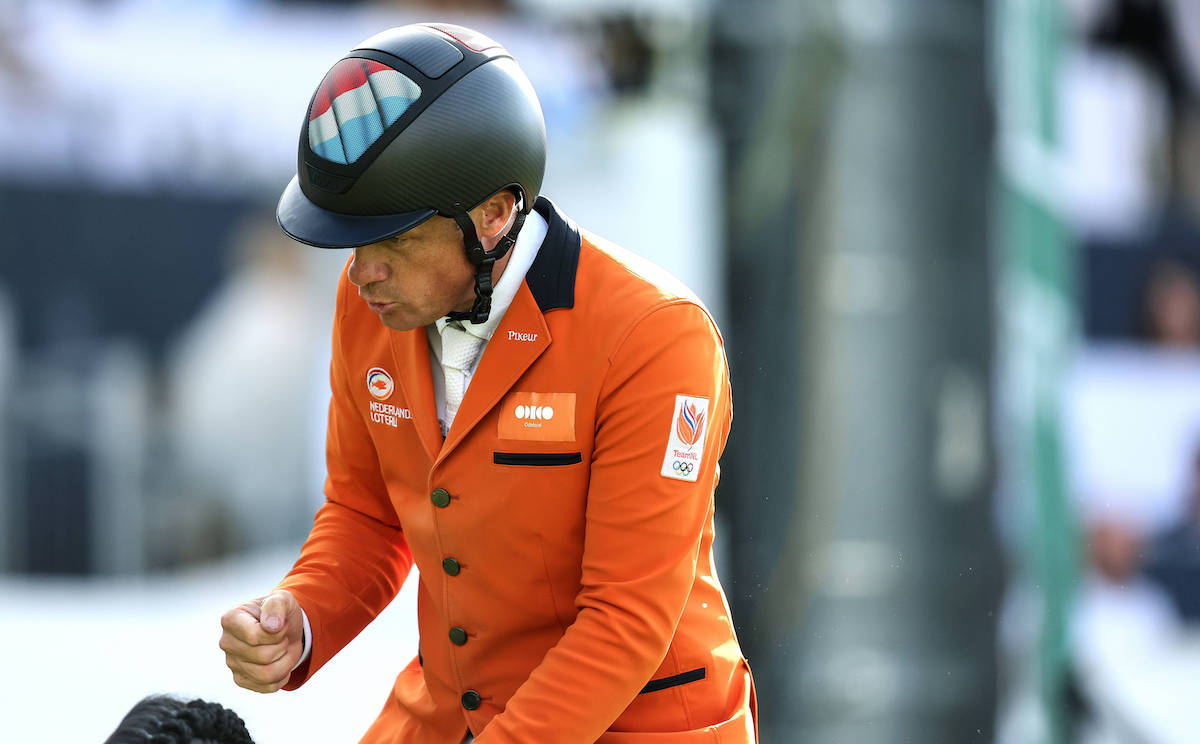
And there they were on the podium in their distinctive orange jackets, festooned with sashes, holding over their heads the golden Aga Khan, shining as bright as Molly Leave her mAlone’s oft-rubbed bosoms!
Team Germany landed the silver spot and Team Ireland held on for bronze.