
 June 29, 2026
Ok, I know what I said in my last recap: nothing is better to me than an obsessive, melancholic rider in the mold of Greve or Kukuk, BUT—
Did I also mention that nothing is better to me than a couple of riders filled with joie de vivre and passion for sport who also are shown kissing, cuddling, and crying over their baby horses in a field?
It’s Matthew Sampson of Great Britain and Kara Chad of Canada, in love and engaged and lighting up the small screen in this, the fourth episode of Faultless: The Riders, Their Horses and The Pursuit of Excellence.
Geez, these two got charisma. And lucky for us, they’re headed to Hickstead, the next stop on the Faultless World Tour.
(Now, I’ll admit right now I’ve never been to Hickstead and recognizing this negligence, I’ll be getting on a plane in just over two weeks to remedy the situation. Stay tuned!)
Founded in 1960, Hickstead was the first permanent show ground for equestrian sports in the United Kingdom and, we are told, a major inspiration for the founders of Spruce Meadows. The founder of Hickstead, Douglas Bunn, was influenced by the Hamburg Derby and decided to create his own, British version, the now-famous Hickstead Derby. And he made sure the Hickstead bank was a solid six-inches higher than the one in Hamburg.
A google search finds me this man’s obituary and these delightful sentences: “Bunn was a bon vivant and his Hickstead parties were legendary. He had an excellent wine cellar.” Also: “He was married three times and had ten children.” (Legendary parties, indeed.)
In Faultless, we are not treated to any scenes from the derby (nor from any legendary parties), as it is not a part of the five-star show, just as the famous Spruce Meadows derby is not a part of the Masters. Oh, well. I still think we should indulge ourselves in a further reminiscence from Bunn’s obituary:
In 1971, the Derby was won by Harvey Smith who took the trophy home and “forgot” to return it the next year. There was much brouhaha over the missing trophy, but Harvey insisted it was of little matter, as he intended to win the derby again, so transport of the trophy from his home would have been nothing but an unnecessary bother.
Win it again he did, and, flying past Bunn on the balcony of his box, he flashed him the “V-sign,” which in British gesticulation is the same as the middle finger.
Later, Smith said: “It was all good clean fun. I was just being myself. All those sportsmen today, they just gag them. They’re like zombies. There’s no characters left.”
The powers-that-be at Hickstead confiscated Harvey’s prize money for the offense, but he fought back, bringing in photos of Winston Churchill flashing the V sign after a military victory in World War II and swearing he was not saying “Up yours!” (although he admitted to it), but rather was signaling a V for Victory. He won the argument and was granted his prize money.
But perhaps we should get away from famous show jumpers of yore and return to the ones of today.
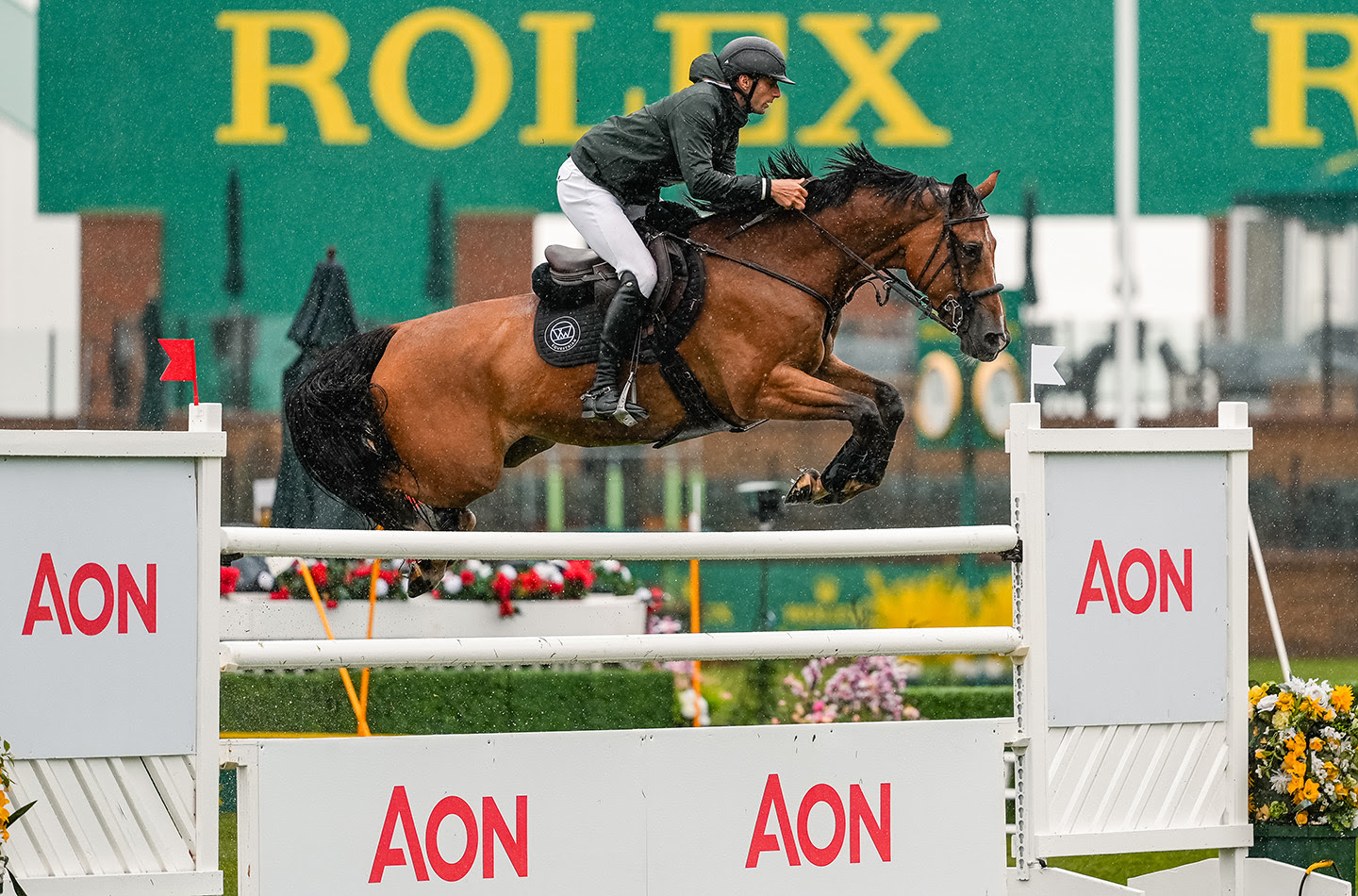
Here is Matt Sampson from Sheffield, who was “born ready,” a guy who “doesn’t want to participate, he wants to win.” He grew up at his mother’s riding school, opened when she was only 18 years old. This was where the family lived and worked and where Sampson learned to ride.
And we are introduced to his fiancée, Canadian Kara Chad, whom he met in Spain six years ago and has been with ever since. Chad describes her own approach to show jumping as “aggressive,” but then admits to the biological impulse to make some little Chads and little Sampsons, as her fiancé is shown charmingly mentoring a young up-and-coming show jumper, 15-year-old Taio Strevett.
(Incidentally, Strevett is described as having amazing “body control” and the reason for this is given that he used to be a gymnast. Now I can testify directly to a gymnast’s facility at sitting quietly on a horse: my niece is the same, and her sport for most of her young life was gymnastics. For this reason, I think it behooves us all to start recruiting at gymnastic schools. Nothing too aggressive (not like Chad), just go in and ask who might have been born with the love of horses and kindly point out that a gymnast is usually done by the age of 18 or 22, while a show jumper can keep going until 70).
We are treated to some scenes from Hickstead’s Nations Cup. Sampson is not chosen for the team, but is instead relegated to taking some non-equestrian fancy people on a tutorial course walk, which he does with hospitality and good cheer.
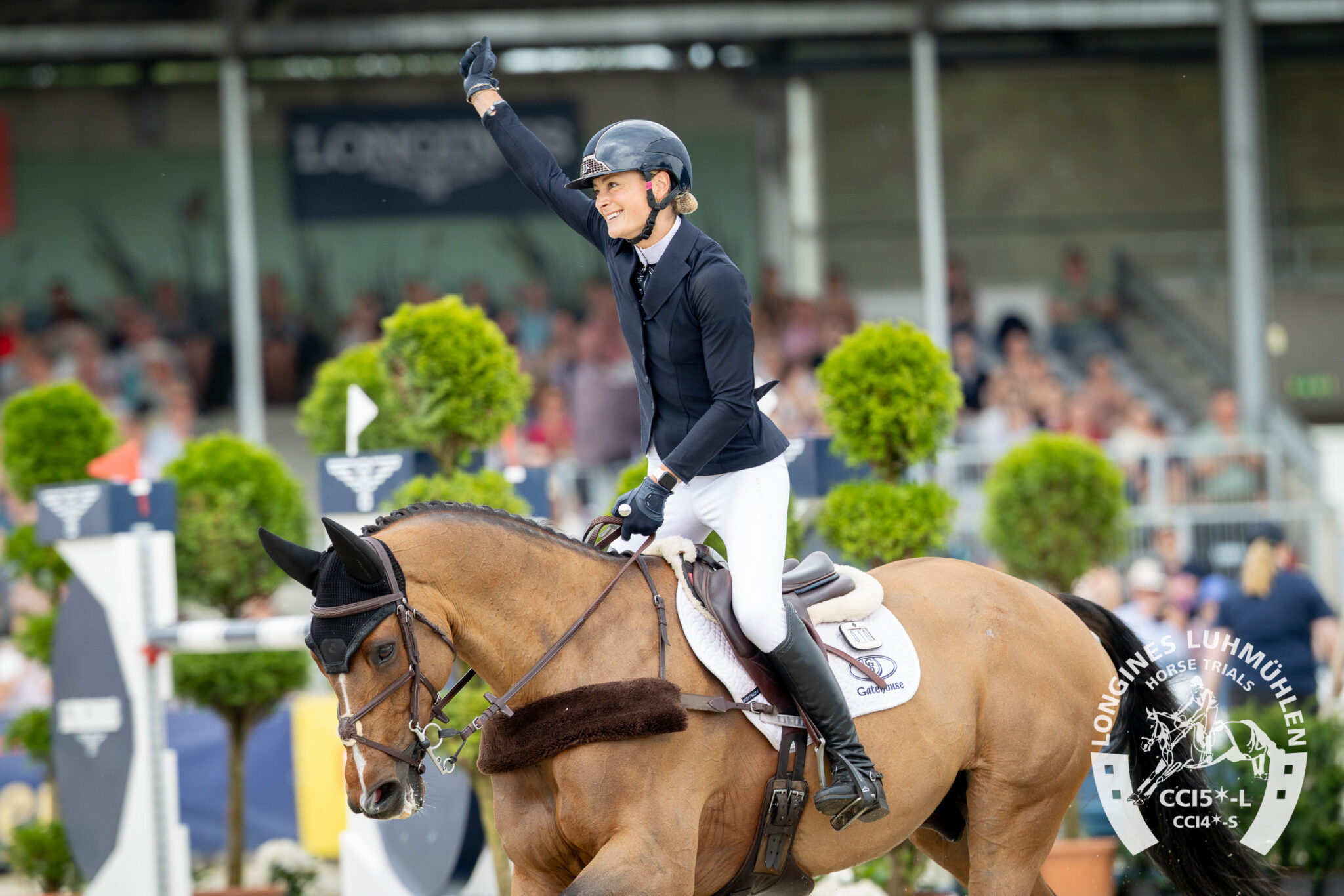
Now enters Jessica Mendoza, another British show jumper and one who has made the Nations Cup team. She is heading to Hickstead with her brother-and-sister pair of horses Summerhouse and In the Air. (It should be noted that if horses are referred to as siblings, it invariably means they share the same mother, as same-sire siblings are obviously super-abundant. In this case the dam they have in common is an Indoctro mare named Selva.)
From the moment she was on a pony at a very young age, Mendoza knew what she wanted to do as a career. For most of her life, her father was her coach, but now he is retired, following her around the world as her number-one fan, while she builds her business and, as a supporter of women in sport, mentors her young female clients.
Anyone who’s seen Mendoza ride knows she’s fast and uber-competitive. Here at Hickstead, the Brits have won the Nations Cup no less than 38 times and now, with the Faultless cameras rolling, they want that 39th win. The Brits also took home (or kept home) the trophy in 2023 and 2024, so they’re going for the hat trick.
Unfortunately, it is not to be, despite Mendoza perfecting her first-round 8 faults into a second-round clear. I’m so used to seeing Team Great Britain rise from near the bottom of the placings up to the top, something they seem to do routinely, that I cannot help but be bitterly disappointed as a viewer.
But I feel it does deserve mentioning. How do they do it? Is it chef d’equipe Di Lampard? Is it part of the British character? Is it that Churchill quote they love to put on coffee mugs and magnets: “Never never never give up!” (see footnote)? Most of the time, things get rougher in a second round of a Nations Cup, as horses become tired, but Team Great Britain loves rising from the underdog position. I mean they just did it again at the latest Longines League of Nations, with a team also sporting Mendoza.
This time, despite Mendoza’s comeback round, Germany sits at the top and Great Britain settles for second.
We are back to Sampson and Chad, who proceed to win this recapper’s heart with scenes of the aforementioned kissing and cuddling of baby horses. They began their breeding program a few years ago because, according to the narrator, “every rider is eager to develop a deep pool of horses to compete with.” Who doesn’t want to swim in those waters?
Grand Prix day arrives, but it is rather a letdown for our two principals. Mendoza has a high-scoring round, which is unfortunate, because if this is all we see of her in the series, it really wasn’t representative of her blockbuster summer 2025 campaign (she scored her first five-star Grand Prix win a month later with In the Air at the Hampton Classic in New York.)
Sampson comes a bit closer, but still fails to achieve the jump off with a four-fault round. “What a fuckup,” he says. “Don’t know how else to put it!”
Ok, it’s not Kukuk-level baroque poetry, but Harvey Smith would approve!
Stay tuned for our next stop: Dublin!
Footnote: The actual quote: “Never give in—never, never, never, never, in nothing great or small, large or petty, never give in except to convictions of honour and good sense. Never yield to force; never yield to the apparently overwhelming might of the enemy.”
Up for more Faultless? Read Erica Hatfield’s previous recaps: