October 2, 2026
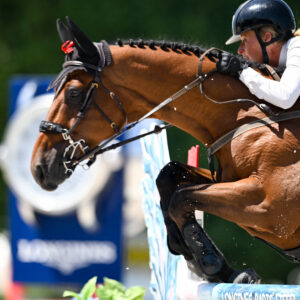
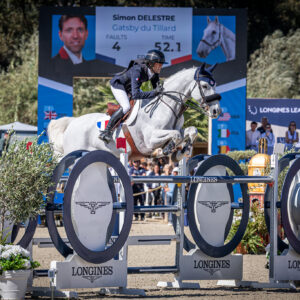
Like many professionals, falling off comes with the territory for Canadian show jumper Will Martin. But after the 20-year-old was cleared to jump again after an unplanned dismount, he noticed things weren’t quite right.
It all came to a head one day when the fence he was approaching on a horse suddenly appeared to be moving.
That incident resulted in yet another accident, exacerbating what turned out to be a previously undiagnosed concussion, and benching Martin for a significant period of time.
The Canadian rider was sent to the University of Miami’s Acquired Neurosensory Disorder and Treatment Lab, where Dr. Sergio Guerreiro, AuD, an assistant professor of clinical otolaryngology, and Dr. Erin Williams, Ph.D., evaluated and treated him using a special Passive Neurosensory Reintegration Training (PNRT) table.
PNRT therapy aims to help the brain relearn how to utilize visual and balance-related signals using a multi-axial platform, which allows it to move gently in different positions. During the process, patients are also exposed to different wavelengths of light and auditory stimulation.
“This table is essentially a bottom-up approach to therapy,” Dr. Minesinger told US Equestrian’s Kimberly Loushin in a recent story for USEF Insider. “Traditional therapy technically falls under an executive functioning, top-down approach. You’re told to do a task and you perform it.
“But if you’re concussed, that’s hard to do because your brain is struggling to perform normally. A bottom-up approach means we’re targeting the ‘automatic,’ or subcortical part of the brain—or the part responsible for normal processes you don’t normally think about.”
Martin responded to treatment, and eventually returned to competition. But his results left Drs. Guerreiro and Williams—both riders, themselves—scratching their heads.
“What we’re noticing when we’re performing some of the optometry exams, where we’re basically looking at depth perception and how well the eyes work together at different distances, an equestrian’s ability to perform those eye movements are really impressive,” Dr. Kayla Minesinger, Ph.D, an entry scientist at the University of Miami explained.
“They’re able to do these really challenging eye movements that you wouldn’t typically see in a normal person within that age group. That’s why it’s important to get baseline normative values for equestrians without head injuries, because their normal values are probably different from another athlete.”
In essence, the reason why Martin and other riders are sometimes prematurely cleared by doctors after suffering a concussion is that their baseline values during evaluation are often higher than the normative value for your average, non-rider. According to Dr. Williams, at present, the most important indicator of a concussion, therefore, is where a rider’s score was prior to their injury, not how they stack up to a general baseline.
Equestrian-Focused Research Matters
Some scary stats: 80% of riders will experience at least one head injury in their lifetime, while 42.5% of those who suffer from sports-related concussions are equestrians. Those numbers, alone, should fuel the fire to establish a normative baseline value for visual function that’s specific to equestrians—a subset that already exists for athletes in other sports.
To that end, Drs. Williams, Guerreiro, and Minesinger are planning to gather data on equestrians next year at the Winter Equestrian Festival in Wellington, where they hope to add to the some-30 rider evaluations they’ve already collected.
Because things like age, biological sex, and pre-existing conditions can impact the symptoms, severity, and recovery time for concussions, the information gathered from study participants will include demographic survey information on these factors, as well as daily lifestyle habits. Those will be followed by two concussion questionnaires.
Identifying which type of riding an individual does is also key to the process, as a normative value for jumping disciplines (show jumping, hunters, and eventing) may be different than, say, a dressage or Western pleasure rider.
“Someone who only does dressage doesn’t need the same ability to track distances in relation to yourself as someone who is doing cross-country at the advanced level going over massive obstacles at a gallop over uneven terrain,” Dr. Williams said. “Eventers would need higher functioning oculomotor systems compared to someone who’s not doing those sorts of things.”
After the survey portion of the evaluation, equestrians will undergo two additional tests. The first is a neuro-optometry battery to examine visual processing, how well a rider’s eyes work together to fuse images, depth perception, and how his or her peripheral vision responds to different colors of light.
The second test includes the use of goggles—similar to a virtual reality-type headset—to help scientists gather more refined eye-tracking data involving oculomotor vestibular reaction time.
In this way, the team at University of Miami is hoping assemble visual function criteria that can eventually be used to formulate a normative baseline value that’s specific to equestrians—helping future concussion sufferers receive a more accurate diagnosis and, consequently, improved estimates for when they can safely return to sport.
“Our goal is to get a better understanding, not just for diagnosis, but also to track the effects of therapeutics that come along,” Dr. Williams said. “More information, in our view, is never a bad thing.”