December 4, 2025
Few horses in recent memory have been as well-known or beloved as the British dressage champion, Valegro. This week, the world said goodbye to “Blueberry,” who was humanely euthanized as a result of chronic old age concerns alongside his longtime friend and fellow British dressage champion, Uthopia. The horses were aged 23 and 24, respectively.
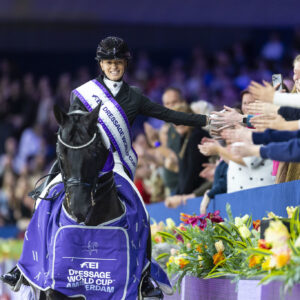
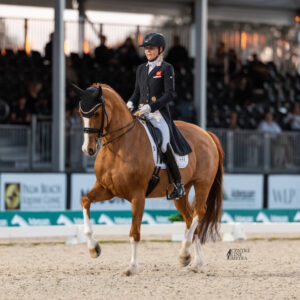
During an international career that spanned six years, the KWPN gelding ridden by Charlotte Dujardin became the most decorated dressage horse in British history. As double-gold medalists at the 2012 Olympic Games in London, the pair went on to earn individual gold and team silver four years later in Rio de Janeiro, setting Grand Prix, special, and freestyle records wherever they went.
In fact, from 2014 to 2015, Valegro and Dujardin held Olympic, World, World Cup, and European Championship titles simultaneously—the first horse and rider ever to do so. And, as the charismatic equine face of the sport, Valegro opened dressage up to a whole new audience, while his partnership with Dujardin made the discipline accessible to the next generation of big-dreaming, horse-crazy boys and girls.
“We had no idea how our worlds would change,” the British rider wrote in her farewell tribute to her old partner. “Just a girl and a horse, trying our best.”
While Dujardin’s 2024 FEI suspension for whipping a horse in training cast a shadow on their legacy—just one of many recent, welfare-related incidents that’s put previously overlooked dressage practices under the microscope—Valegro, himself, was an example of the kind of athlete the sport could produce.
The laid-back yet statuesque gelding with, as Carl Hester famously coined, “the head of a duchess and the bottom of a cook,” always gave 100% in the ring, while appearing to enjoy his job.
Perhaps Valegro’s greatest gift, however, was the ways in which his talent, good looks, and gentlemanly disposition created a platform for good in the sport of dressage and beyond. Here’s how…
1. Valegro trained in a snaffle.
While Blueberry, like most of his contemporaries, competed in a double bridle, at home the gelding primarily worked in a snaffle. “I don’t know if most of you know this, but most of the time when I was training this beautiful horse [Valegro], I mainly did it in a snaffle. Only really putting the double bridle on every few weeks, or the week leading up to the show,” Dujardin revealed on Facebook.
“My feeling is I always want to be able to do everything in a snaffle to the highest level and not ‘rely’ on a double. For me, it’s so important.”
2. He enjoyed regular turnout.
According to Carl Hester’s program, even when he was competing, Valegro was turned out regularly throughout the summer and during dry days in the winter months. He typically went out in paddocks next to Hester’s fellow Olympic mounts, Uthopia and Nip Tuck.
3. He helped bring helmet-use to the forefront.

Until 2021, the FEI allowed for the use of top hats in international dressage competition. But since Valegro’s earliest days in the spotlight, you’d be hard-pressed to find a photo of Dujardin mounted without a helmet on—despite having claimed she had never fallen off of him. In fact, until Charles Owen cut ties with the British rider following her suspension in 2024, Dujardin was the brand’s most prominent face and advocate for helmet-use in dressage. She even donned one for her trot-up with Gio at the 2021 Tokyo Olympics.
4. Valegro helped normalize hacking out for high performance horses.
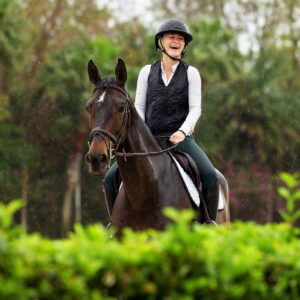
Although he was at home in elite dressage arenas all over the world, Valegro’s happy place was trail riding out in the field, a twice-weekly part of his routine that he enjoyed throughout his competition years. The gelding was such a steady Eddie on trails, he was often hacked out by then-70-something former British Olympian, Tricia Gardner.
“She literally drags Blueberry to the highest mounting block she can find and makes him stand in a position which is good for her to climb on from, faffs around a bit and drags herself up,” Dujardin told Horse & Hound in 2015. “You would honestly look at him and think he was a bog-standard, happy hacker. He then goes up the road with her, eating his way through any hedge he can find.”
5. His gentle sprit brightened lives.
Many highly-attuned equine athletes of Valegro’s caliber have a hard time adjusting to their new routines outside the show ring after the curtain closes. But Blueberry’s gentle nature was an example of what a well-trained, well-cared-for athlete can become even after his international career was over. Throughout his retirement, the gentle gelding continued to gamely give back to the public at events, demonstrations, and beyond.
“He’s still a star. Many might imagine a gold medalist to be a fiery, wild beast that needed taming, but Valegro is far from it,” Carl Hester said in 2020. “We have sick and terminally ill children come to the yard and they can ride him, he brings so much pleasure to them.”