September 16, 2025
This is an origin story.
I am at the Getty Center in Los Angeles, California and, in a fit of mischievousness, I’m trying to embarrass my friend.
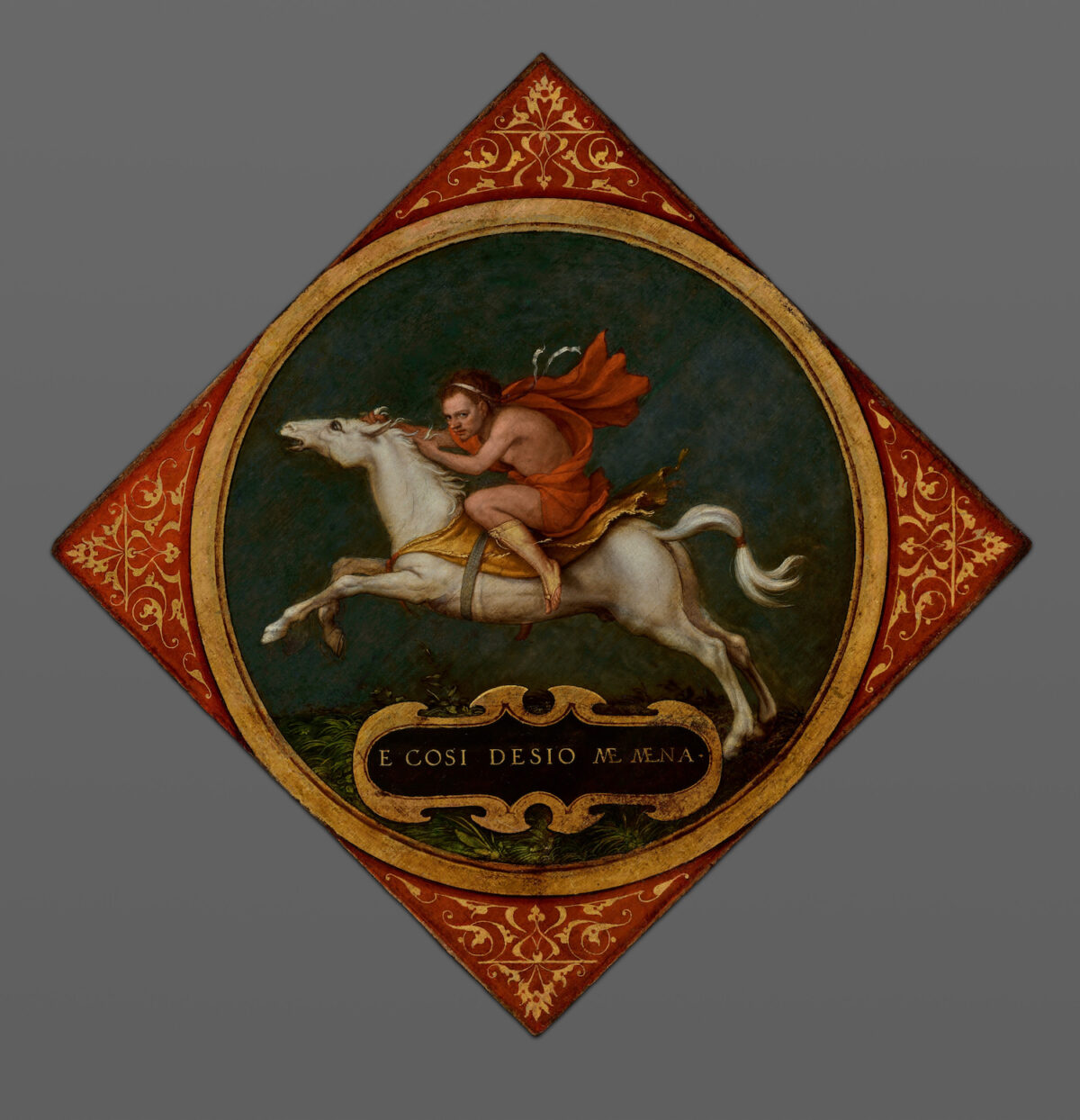
We are in front of “An Allegory of Passion,” an 18-inch wooden square, painted and hung so it forms a diamond shape, like a crest or a badge. Inside the square is a painted roundel and painted inside that roundel is a white horse at full gallop, bridleless, his head high, his neck stretched, his mouth open. Astride the horse, hunched over bent knees like a jockey, is a young man barely clad in fabric, which rides up his bare thighs and flows back in the wind that catches it, exposing his muscled upper torso.
He holds on to the mane and forelock of the stallion and turns his head to meet our gaze. His face is ruddy, his eyes are shadowed by his brow, his lips are full. He has the beginnings of a beard.
The horse’s stride arches over a gold-framed cartouche. It reads: E cosi desio me mena. Translated from the Italian, “And so desire carries me along.”
“In this painting,” I say loudly, positioning myself next to the artwork, facing the room, “we see how horses are so often used in art, as symbols of human emotion.”
My friend turns bright red. “Shhh!” She tries to quiet me.
I didn’t care. I wasn’t thinking of the painting. I wasn’t thinking of the small crowd that had started to form around me. I was only thinking of how I could make my friend squirm with the humiliation of having me as her travel companion.
I was flexing my most bountiful talents. Loud-mouthed, gesticulating, with the attention span of a gnat, I had flitted around inside the walls and across the campus of the museum, fascinated until I wasn’t, interested until I didn’t care anymore. I love museums, but I take them as I want them. Tickle my brain and sell me a refrigerator magnet. I never linger, because I cannot afford to find myself bored by the treasures of civilization. Each time I return to you afresh.
“Here we see a wild white stallion, unbridled, uncontrollable, the rider clinging to the back, to the mane. The stallion represents lust, untameable desire—”
It was something about the woman with the short hair and the glasses, her earnestness. She had taken a place only a few feet in front of me, gazing at the painting thoughtfully. It was no longer only my friend who was embarrassed, but me. A fraud!
My words, which up until that moment, had flowed like water through a suddenly-broken dam, ceased. I stood awkwardly in front of my hastily-assembled audience. Then, abruptly, I fled.
From the room, from the building, out into the terraced campus of the museum, where my friend followed—laughing at me.
But I never forgot that moment and the way people jumped from their meanderings around the museum to join me in looking at the painting. “There is something about the outside of a horse that is good for the inside of a man,” says a quote, which, like most, is often, if erroneously, attributed to Winston Churchill. This is perhaps true not only for the living animal, but for art as well.
As soon as I returned to my hotel later that night, I searched for more information on the painting. It is a small thing, oil on an oak panel, painted by the German Hans Holbein the Younger, a renowned portraitist and painter, sometime in the 1530s.
The first known owner was Henry Frederick, the Prince of Wales, who bequeathed it to his younger brother in 1612. That brother later became King Charles the First and had his head lopped off during the English Civil War, at which time the painting moved on. The Getty acquired it by purchase in 1980.
Whoever it was that first commissioned the painting is unknown.
The words on the painted cartouche give a clue. They are from the poet Petrarch’s Canzoniere, a collection of poems written in the 1300s that celebrated his love for a woman named Laura. Laura, with whom he fell in love at first sight when he saw her standing in the St. Clair Church in Avignon. That moment led to a lifelong obsession and over 300 sonnets written over 40 years, 20 of them after Laura’s death.
So the original commissioner must have been a Petrarch scholar, say researchers. A Petrarch scholar! What a dry supposition. I imagine a young man, perhaps the young man whose features appear on the face of the rider, aflame with an unyielding infatuation of his own, hanging on for dear life to the forelock of the passion that carries him away…
And that is the moment that I became an equine art historian. Or, if such an appellation confers authority I do not deserve, that was the moment I became interested in it. And, like the rider in the portrait, I will, in the days and months and years to come, let my passion lead me where it may.