
 January 19, 2026
And the weather turns slightly chilly during the week. There’s some rain. A wind kicks up.
I am in bed with woolen socks and an enormous sweater that I could belt and wear as a dress. Which reminds me of a joke: “What did the zero say to the eight? Nice belt.”
I have another sweater that is black and says WEIRDO in white across the chest. Everyone says it’s apropos.
Cold weather delights me and the horses and the dogs. The cats are not as happy. They eat too much and too fast and vomit on the floor and I step in it but don’t feel it due to the thick woolen socks. I track it around a bit before noticing. Other animals not so happy are the humans.
Horses first evolved in North America as little fox-sized creatures that lived in forests. That was about 55 million years ago. They didn’t have hooves, they had spread-out toes that helped them to walk over the moist and mushy ground. Then the grasslands appeared and they decided to switch their diet and lengthen their limbs to outrun predators.
They started crossing over the Bering land bridge, that piece of land that connected Alaska to Siberia, the same way humans came to North America. I guess they passed each other, one going one way, the other going the opposite.
The first relationship between humans and horses was that of a man and his dinner. They say this is why horses disappeared in North America, although some blame the Ice Age. Most blame both. One thing most people don’t realize about killing off large mammals is you don’t really need to do one bloody, wholesale slaughter, you just need to kill enough off—usually the young, as they are easier to kill—to make the population unable to maintain itself. This can happen over decades or centuries or even millennia.
But despite being killing off in North America, equines escaped and continued on in Asia, on the Eurasian steppe.
As I lay in my bed in my enormous sweater, I google the weather on the Eurasian steppe. Specifically, the Pontic-Caspian steppe, which stretches from “Romania to Bulgaria through Ukraine and Russia to Kazakhstan.”
I am doing this because I want to go outside and yell at the African-evolved primates that I and the horses are always hot and we love this weather because we are a hardy, northerly species and hardly adapted to the Swamp (southern Florida) at all, although I don’t know why I am talking this way because I am one of the primates. But cold weather also lets me wear my aforementioned WEIRDO sweater.
Speaking of talking, some like to talk about the Botai-domesticated horses (appearing around 5,500 years ago), Botai being also in what is now Kazakhstan, but those horses were bred for milk and meat and reportedly had enormous heads and bellies. They say there’s little genetic evidence that links these horses to ours, but I’ve seen many at the show grounds that have just this physiology.
It’s a better idea to breed horses for mobility. Once humans stopped eating them and jumped on their backs, this animal spread like wildfire throughout the world and even made it back home to North America on the ships of Spanish explorers.
But I am still trying to make my point, so I note the weather on the Pontic-Caspian steppe: long, cold winters and short, brutally hot summers. Winds and storms that rush unimpeded across the open plains—fierce winter blizzards and hot “black blizzards” that are massive, blinding dust storms.
It’s not exactly making my point, those stupid hot dust storms getting in the way of my cold-weather argument. But I find myself being seduced by the drama of it, I feel myself being seduced by the extremity of the origins of this creature that is able to withstand the hot and the cold in equal, stoic measure.
Next to them, I think of the lot of us as scuttling little bugs, always moving, possessing very little dignity compared to the creature we serve and that serves us.
It’s always like this. My relationship with horses is hardly practical, but that of a stunned and awestruck observer, lost in contemplation like reverence.
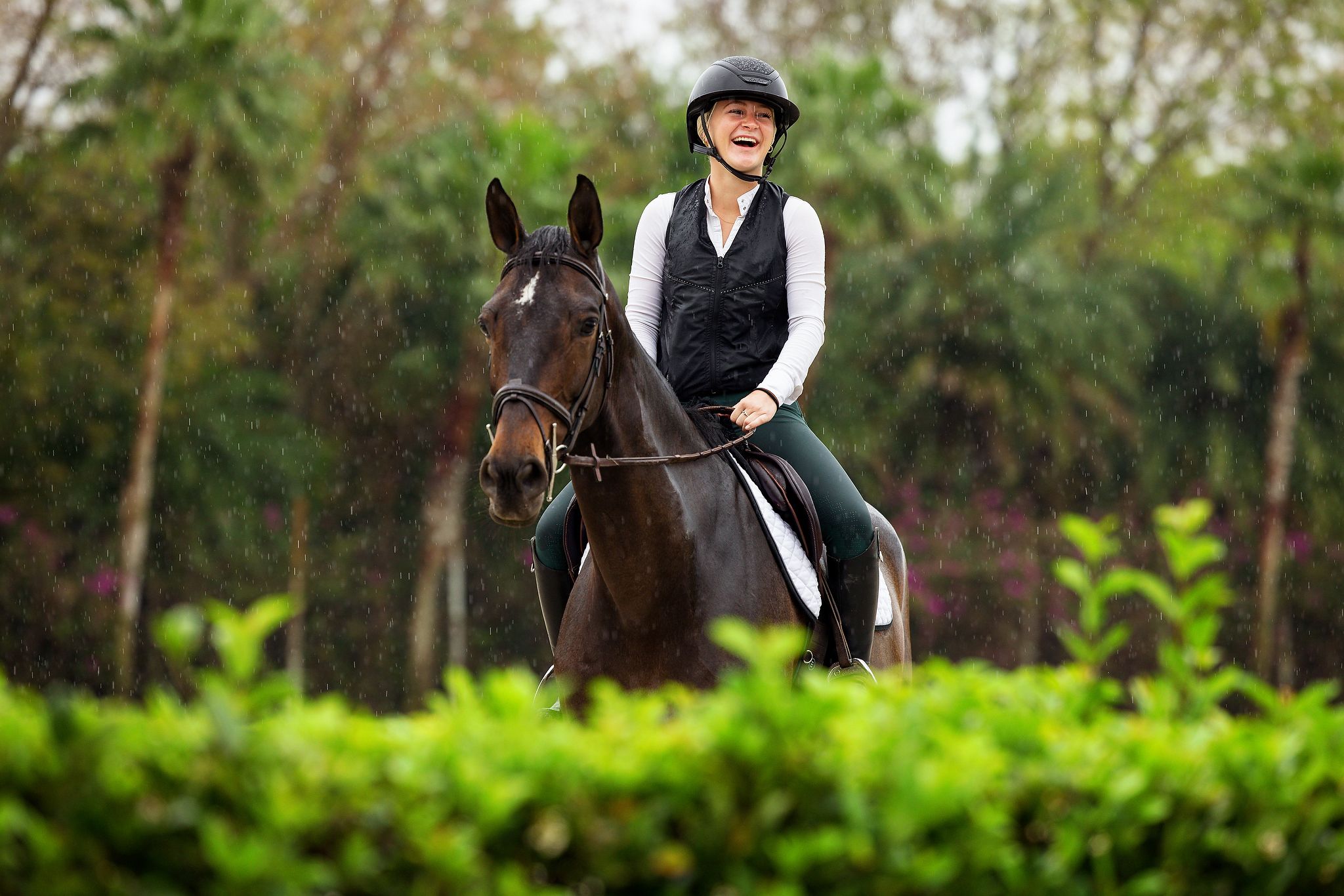
On Sunday, it is raining, then it is not, it dawns cold, then it turns hot. I put on the sweater, then take it off. I wear long pants, then regret it as the muggy air covers my skin with a film of sweat that runs down my back. At the show, the wind whips up and knocks over the standards.
Writing about weather? What could be more boring. I know somewhere Hemingway said the weather was always in his stories, because he was a simple writer and could only look outside and see what was there and write it down.
When I met this horse show world, I was amazed how the show went on despite the rain. In college, I used to walk back from class in the rain and watch everyone duck inside. I remember one time being outside the dining hall in the rain and sitting down on a short stone wall outside without umbrella, without jacket. “I have nothing to protect,” I thought as I watched people rush inside.
And once, on the beach down here in Florida, wind and rain kicked up and there I was, standing in it alone, while the woman next to me received the coat of her companion and his sheltering embrace. “I have nothing to protect,” I thought again. I was a depressive in those days.
Once I fell in love very briefly for a week and we were walking along the street in a small town and the wind and the rain kicked up so that the streets were gushing with water and I was standing there in it while my companion rushed inside and there I was alone, but that’s how it is—I prefer standing in the rain to running from it.
So when I met horses and the horse show world, I met my people who do not run from rain and I really saw it as a sign that I had arrived somewhere I was supposed to be.
“Have you let yourself be seduced by the right things?” someone asks. That someone is me, and I think it’s a pretty good question.